


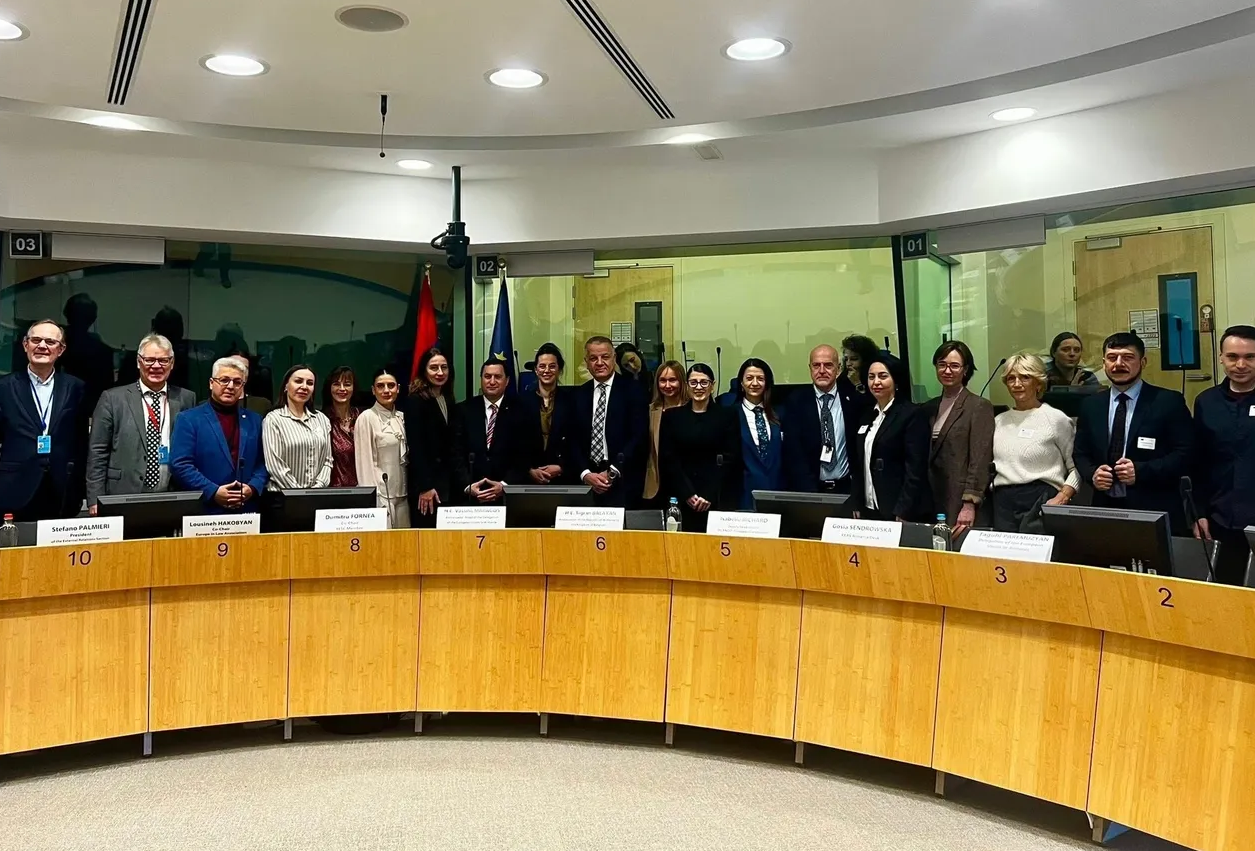
The the meeting of the EU-Armenia Civil Society Platform was held on December 5th 2025 in EESC Headquarters (Brussels, Belgium)
1. Welcomes the outcome of the 6th EU-Armenia Partnership Council held on 2 December 2025 in Brussels, which reviewed the implementation of CEPA and the revised roadmap, taking stock of progress on reforms, democracy, rule of law, human rights, mobility and the visa-liberalisation dialogue. Points out that the Council also addressed economic and sectoral cooperation, with particular attention to energy reforms, the renewable transition and connectivity, topics that were likewise extensively discussed during the meeting of the Civil Society Platform.
2. Welcomes the intensification of EU-Armenia bilateral relations, reflected in a series of high-level visits during 2024-2025, and acknowledges this growing political engagement as an important pillar of the partnership, while underlining that this momentum must be matched by continued progress on the reform agenda.
3. Calls on the European Union to continue using all appropriate diplomatic, political and economic instruments to support conditions for the safe, dignified and voluntary return of displaced Armenians from Nagorno-Karabakh, in full respect of international law and relevant orders of the International Court of Justice, including the Order of 17 November 2023. Underlines that any such return must be accompanied by effective and verifiable guarantees for the protection of the rights and security of returnees, including through adequate international monitoring arrangements agreed by the parties.
4. Welcomes the handover of the Visa Liberalisation Action Plan and encourages close cooperation with civil society and social partners throughout its implementation, particularly on benchmarks relating to border management, migration governance, anti-corruption, data protection and fundamental rights.
5. Welcomes the ratification of the Framework Participation Agreement enabling Armenia’s participation in EU crisis-management missions, representing a significant step in deepening cooperation on security, defense and human-security standards.
6. Welcomes the finalisation and signing of the new EU-Armenia Partnership Agenda as an ambitious framework complementing CEPA, strengthening cooperation on security, resilience, economic diversification, and regulatory approximation under the Resilience and Growth Plan. Emphasises that its implementation should be inclusive, transparent and grounded in democratic values and human rights.
7. Emphasises the need to accelerate reforms in the rule of law, justice, public administration, human-rights protection, policing, and penitentiary and probation services, and calls for strengthened efforts to ensure transparent, effective and timely implementation of these reform strategies.
8. Notes continued concerns raised by civil society and international monitoring bodies regarding instances of excessive use of force by police and the need to strengthen independent and effective investigations into such cases, ensuring accountability and public trust.
9. Underlines the importance of safeguarding equality before the law and ensuring that pre-trial detention is used only as a measure of last resort, in line with European standards. Notes concerns expressed by stakeholders regarding its frequent application and encourages continued efforts to strengthen judicial oversight.
10. Highlights the need to ensure that freedom of expression remains fully protected, while any limitations must comply with international human-rights standards, pursue legitimate aims, and be necessary in a democratic society.
11. Notes both the institutional progress Armenia has made in establishing a comprehensive anti-corruption framework and the persistent challenges identified by international assessments, including in ensuring strategic prioritisation, institutional capacity, and effective implementation.
12. Acknowledges the operationalization of the Corruption Prevention Commission, Anti-Corruption Committee, specialised Prosecutor’s Office units and the Anti-Corruption Court, while recalling the need for strengthened independence, adequate resources, and improved implementation practices, as highlighted in international evaluations.
13. Encourages continued reforms to enhance asset-forfeiture mechanisms, beneficial-ownership transparency, and oversight of public procurement and private-sector integrity, ensuring alignment with European and OECD standards.
14. Notes that, while the adoption of the revised Labour Code represents an important step, its effective implementation requires strengthened enforcement, monitoring, and structured social dialogue among employers, trade unions and government.
15. Emphasises the need for strengthened cooperation between education institutions, social partners and public authorities to better address skills mismatches and support a modern, competitive economy.
16. Stresses the importance of modernising Armenia’s occupational safety and health (OSH) framework in line with CEPA and EU standards, including a shift towards a preventive, risk-based approach supported by adequate enforcement capacity and employer training, and of developing clear timelines and implementation roadmaps for Armenia’s OSH commitments under CEPA.
17. Welcomes Armenia’s ratification of ILO Convention No. 190 and its integration into the Labour Code, and encourages the development of clear implementation mechanisms, including support to SMEs and all other types of businesses, regardless of their size, and capacity-building for labour-inspection and judicial bodies.
18. Underlines the importance of ensuring that Armenia’s green transition is socially just and inclusive, and encourages the development of a comprehensive Just Transition framework aligned with CEPA commitments and in view of Armenia’s hosting of COP17 on biodiversity.
19. Notes that full implementation of the new VET framework requires the timely adoption of outstanding sub-legislative acts and strengthened, institutionalised cooperation with trade unions and employers to ensure high-quality, labour-market-relevant training.
20. Recognises persistent challenges relating to youth unemployment and NEET rates, and calls for enhanced coordination between employment services, VET institutions, trade unions and employers, with special attention to rural areas and vulnerable groups.
21. Highlights the importance of entrepreneurship and SME development in generating sustainable employment, and encourages further support for youth and social entrepreneurship, innovation ecosystems and green-economy initiatives.
22. Stresses that transparency, predictability and accountability in implementing the new legislative package – together with clear and timely guidance for businesses, workers and social partners – are essential for strengthening trust and enabling all stakeholders to fully contribute to CEPA-aligned labour-market modernisation. Highlights the importance of well-resourced institutions and reliable monitoring mechanisms to ensure that legislative reforms translate into tangible improvements in practice.
23. Reaffirms the commitment of civil society, including trade unions and employers’ organisations, to constructive social partnership and to contributing technical expertise in the elaboration of sub-legislative acts, labour-market forecasting tools, apprenticeship standards and skills-governance mechanisms, in order to support effective implementation of CEPA and the revised cooperation roadmap.
24. Acknowledges the introduction of several initiatives and draft bills to reform labour and social governance, while noting that significant challenges and gaps in employment and social rights persist. Underlines the importance of consistent implementation, effective enforcement mechanisms and meaningful stakeholder participation to ensure that reforms deliver the intended outcomes for workers, employers and the wider society.
25. Stresses that international labour standards related to collective bargaining and consultation rights remain essential for democratic governance, social cohesion and sustainable development. Notes that key preconditions for effective social dialogue, including a functioning national collective bargaining system and an enabling environment for private- and public-sector bargaining, are not yet fully ensured, and encourages accelerated efforts in these areas.
26. Underlines that meaningful and institutionalised tripartite social dialogue is central to the design, implementation and monitoring of labour, social and economic policies. Calls for strengthened structures and processes, also on a sectoral level, that enable the constructive and effective participation of trade unions and employers’ organisations.
27. Encourages the Armenian government to identify an appropriate and representative social dialogue mechanism with sufficient capacities for state and civil-service workers, with a view to establishing a functional collective-bargaining system for the public sector, in line with international labour standards and CEPA commitments.
28. Welcomes the introduction of a draft law amending the Trade Unions Act as an important step towards enabling the right to collective bargaining and strengthening workers’ rights at company level. Encourages continued dialogue among social partners and the authorities to ensure that reforms are comprehensive and that rights are effectively upheld at national, sectoral and enterprise levels.
29. Notes concerns expressed by trade unions regarding cases of interference with workers’ rights to organise, particularly in certain state and municipal bodies, and encourages the authorities to take appropriate measures to safeguard the independence and protection of trade unions, in accordance with international standards, and to establish and implement sufficiently dissuasive sanctions for trade union rights violations.
30. Highlights the importance of ensuring that senior officials in state bodies and local governments possess adequate knowledge of international labour rights, CEPA-related obligations and principles of social dialogue. Encourages the introduction of merit-based requirements and training programmes on labour standards, collective bargaining and workers’ rights as part of selection and promotion procedures for managerial positions.
31. Welcomes the progress made towards the development of a Universal Health Insurance system, which represents an important step for strengthening social protection. Encourages continued dialogue with stakeholders to ensure that the design of the system is transparent, equitable and financially sustainable, and that it contributes to improved access to quality healthcare for all groups, including vulnerable populations.
32. Notes the persistent challenges facing Armenia’s enforcement and inspection systems and underlines the need for comprehensive institutional reform to strengthen compliance assurance, regulatory oversight and the capacity of inspection bodies, in line with CEPA commitments and European best practice.
33. Takes note of the steps taken to address cases of irregular employment of foreign nationals and the exploitation of migrant workers, and expresses concern over emerging forms of abusive recruitment and employment practices. Calls for strengthened oversight, enhanced coordination between relevant authorities and improved protection measures to ensure that foreign workers’ rights are fully respected.
34. Encourages the authorities to reinforce transparency and accountability in labour-migration and recruitment processes, including through more robust regulation of intermediaries, clearer rules on recruitment practices and improved traceability of job advertisements, with a view to preventing exploitation and undeclared employment.
35. Recalls that platform employment continues to pose significant challenges in terms of formalisation, workers’ rights and fair competition. Welcomes the steps taken to regulate platform-based taxi services and encourages the authorities to extend regulatory measures to other sectors, including delivery services, in line with Directive (EU) 2024/2831 of the European Parliament and of the Council of 23 October 2024 on improving working conditions in platform work.
36. Welcomes the progress achieved in modernizing Armenia’s transport infrastructure and legislation. Underlines, however, that road-safety performance remains a critical challenge, with fatality rates significantly exceeding regional averages, as highlighted in the Partnership Implementation Report.
37. Encourages the Armenian authorities to accelerate the adoption and implementation of CEPA-related commitments on vehicle safety, periodic technical inspections, roadside checks, the safe transport of dangerous goods and improved working conditions for professional drivers, drawing on European best practice and social-partner expertise.
38. Encourages the European Commission to continue supporting dialogue and confidence-building measures between Armenia and Türkiye, including through diplomatic engagement aimed at facilitating the opening of the land border and the restoration of transport connectivity for passengers and cargo. Underlines that enhanced cross-border connectivity, including rail links, would contribute to regional stability, economic development and strengthened ties between Armenia and the European Union’s customs territory.
39. Notes the continued cooperation between the EU and Armenia in the energy sector and welcomes progress on increasing efficiency, resilience and renewable-energy deployment.
40. Encourages deeper regulatory approximation in line with CEPA, including on energy-market rules, transparency and environmental standards, as well as further investments supported by the EU’s Resilience and Growth Plan.
41. Welcomes the efforts of the Government of the Republic of Armenia to strengthen its energy security, diversify supply sources, enhance food security and broaden its external economic partnerships, in line with CEPA objectives and the EU-Armenia Partnership Agenda. Notes in this context the adoption by the National Assembly of amendments to the Laws “On the Public Services Regulatory Authority” and “On Energy”, and encourages continued regulatory modernisation to support market transparency, resilience and alignment with European standards.
42. Emphasizes the importance of strengthening grid infrastructure, supporting the development of the Caucasus Transmission Network and ensuring a socially just and inclusive green transition, in close dialogue with civil society, social partners and affected communities.
43. Welcomes the recent decision of the Public Services Regulatory Commission concerning the license of the operator of the Armenian Electric Grids, and acknowledges the importance of ensuring transparency, accountability and strict regulatory compliance in the energy sector. Underlines that effective oversight, public-interest safeguards and the integrity of service providers are essential for strengthening Armenia’s energy resilience and advancing regulatory alignment with European standards.